- On sale!
- New


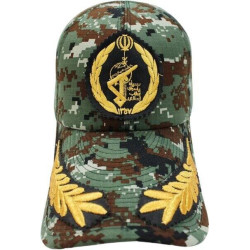
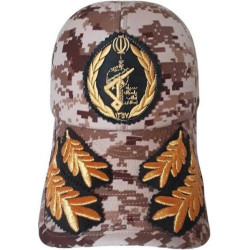
Iran Islamic Revolutionary Guard Corps Aerospace Force IRGCASF IRGC Generals Military Tactical Cap
Size: 61
The Islamic Revolutionary Guard Corps Aerospace Force, officially known as the Islamic Revolutionary Guard Corps Air and Space Force (IRGCASF; Persian: نیروی هوافضای سپاه پاسداران انقلاب اسلامی, romanized: niru-ye havâfazây-e sepâh-e pâsdârân-e enghelâb-e eslâmi, acronymed in Persian as NEHSA), is the strategic missile, air, and space force of the Islamic Revolutionary Guard Corps (IRGC). It was renamed from the IRGC Air Force to the IRGC Aerospace Force in 2009.
Besides operating military aircraft alongside its counterparts in the Islamic Republic of Iran Air Force, the IRGC Aerospace Force is also responsible for space warfare through its military satellite program. Most importantly, it oversees the ballistic missile program of Iran, which includes the deployment and operation of an arsenal of intermediate-range, and medium-range ballistic missiles with ranges over 2,000 kilometers.
Most American public sources disagree and argue on which aircraft are operated by the AFAGIR. The Washington Institute for Near East Policy said in 2005 that "[t]he backbone of the IRGCAF consists of ten Su-25 Frogfoot attack aircraft, including seven flown from Iraq to Iran during the 1991 Gulf War, kept airworthy with the help of Georgian technicians, although reports indicate that all of the IRGCAF aircraft have been sold to Iraq in July 2014, to increase the latter's for CAS and COIN for fighting against ISIS capabilities. All of them were replaced by Su-22", all of them flown from Iraq to Iran during 1991 Gulf War, and around forty EMB-312 Tucanos".
The Washington Institute said that the IRGCAF maintained thirty Y-12 and Dassault Falcon 20 light transports, as well as MFI-17 Mushshak and Super Mushshak trainers, and locally built Ababil and Mohajer reconnaissance unmanned aerial vehicles (UAVs).
The AFAGIR also operates a sizable rotary-wing force consisting of around twenty Mi-171 helicopters for transport and armed assault roles, and a large transport force out of Shiraz, equipped with around fifteen ex-Iraqi Il-76s, originally operated by the IRIAF, and twelve An-74TK-200 transports. Scramble backs up this picture in general, reporting An-74s, An-14s, and Su-22 at Tehran Mehrabad, Chengdu F-7Ms at Zahedan, while saying that MFI-17s were often reported at Zahedan incorrectly, and Il-76 AEW variants at Shiraz Shahid Dastghaib International Airport, while saying that they might be based at Mehrabad.
Other later writings make no mention of Il-76s. Anthony Cordesman of the Center for Strategic and International Studies, writing in August 2007, said only the AFAGIR "may operate Iran's 10 EMB-312 Tucanos", and that it "seems to operate many of Iran's 45 PC-7 training aircraft" as well as Pakistani-built training aircraft at a school near Mushshak, "but this school may be run by the regular air force". He said that reports of the Revolutionary Guards operating F-7s did not seem to be correct.
Cordesman noted claims of the AFAGIR building gliders for use in unconventional warfare, saying that they would be unsuitable delivery platforms, but could at least carry a small number of weapons. However the attached reference was a 1996 Reuters report, making the sources for such assertions extremely thin. The IISS Military Balance 2007 makes no mention of aircraft, referring only to the Shahab 1, 2, and 3 missiles.
In October 2009, it was announced that its name has been changed from IRGC Air Force to IRGC Aerospace Force.
In February 2014, Jane's announced that the Barani missile system had been tested. This system is a laser-guided air-to-surface missile which releases submunitions: "new generation of long-range ballistic missiles carrying multiple re-entry vehicle MIRV payloads". The UN Panel of Experts identified it as a variant of the Shahab (Ghadr 1) and questioned its alleged multiple re-entry vehicle capability, suggesting instead that it carried sub-munitions.
The Bina missile, which can be carried aloft and is able to be ground-launched from a rail car, was also revealed at the time.
The IRGC Aerospace Force is responsible for the operation of Iran's surface-to-surface (SSM) missile systems. In 2006 it was mentioned by John Negroponte that Iran held the largest inventory of ballistic missiles in the Middle East. In August 2013, Ahmad Vahidi former defense minister of Iran said that his country was ranked sixth in the world in missile production. It is claimed to operate several thousand short- and medium-range mobile ballistic missiles, including the Shahab-3/3B with a range of up to 2,100 kilometers, which is the mainstay of Iran's strategic deterrent.
This puts even NATO members Turkey, Greece, Bulgaria and Romania within striking range, if fired from Western Iran. If Iran ever produces nuclear weapons, they fall under the direct supervision of the Aerospace Force. Iran says that it has no intention of producing nuclear weapons. However, there is evidence which points otherwise. A stolen Iranian laptop, containing over 1000 pages of calculations, simulations and modifications required to make the Shahab-3 nose cone capable of carrying a nuclear warhead, was obtained by U.S. intelligence in 2004 and shown to IAEA officials. Additionally, an interview with Alireza Assar, an Iranian physicist formerly tied with the Iranian ministry of defense, revealed the existence of a military nuclear program whose goal was "to produce enough HEU (Highly Enriched Uranium) to enable the regime to produce nuclear weapons". Iran's continuous lack of transparency regarding their nuclear program has resulted in much suspicion regarding its intentions.
According to the testimony of John Negroponte in 2006, Iran's ballistic missile development, together with its enhancement of the navy is largely for the projection of its military power, with the goal of dominating the Gulf region and maintaining its ability to deter and retaliate against adversaries, including the United States. Additional reasons for the indigenous development of missiles may include the regime's intent to showcase its technological advancements, to intimidate and deter neighboring countries, and to reduce its reliance on precarious foreign supplies, particularly from North Korea.
The independent production of missiles in Iran can be traced back to at least 1997, when the country obtained missile plans and production components from Russia and began constructing missile production facilities, including the two tunnels for housing Scud missiles at Kuh-e-Padri, located along the Persian Gulf between Bandar Abbas and Bushehr. Additionally, Iran received assistance from China in the construction of a ballistic missile plant and test range east of Tehran, a production facility near Semnan, and the acquisition guidance technology and precision machine tools. Iran's largest missile production facility, the complex near Isfahan, was built with North Korean and potentially Chinese assistance as the main assembly site for Scud-B missile kits from North Korea.
In May 2013, Iran's Ministry of Defense and Logistics delivered a massive number of missile TELs to IRGC AF, "Iranian television footage showed at least 26 TELs lined up in two rows for the event, which marked their purported delivery to the Islamic Revolution Guards Corps (IRGC) Aerospace Force, which operates the country's ballistic missiles", according to the report by IHS Jane's.
Any Iranian long-range intermediate-range ballistic missile or intercontinental ballistic missile would require an extraordinarily effective guidance system and level of reliability to have any real lethality with conventional warheads, even if it could be equipped with a functional GPS guidance platform. It would probably require nuclear warheads in order to compensate for critical problems in accuracy, reliability, and warhead lethality.
In June 2020, Iranian admiral Hossein Khanzadi said that Iran would start producing indigenous supersonic cruise missiles equipped with turbofan engines soon.
Iran Islamic Revolutionary Guard Corps Aerospace Force IRGCASF IRGC Generals Military Tactical Cap
Size: 61